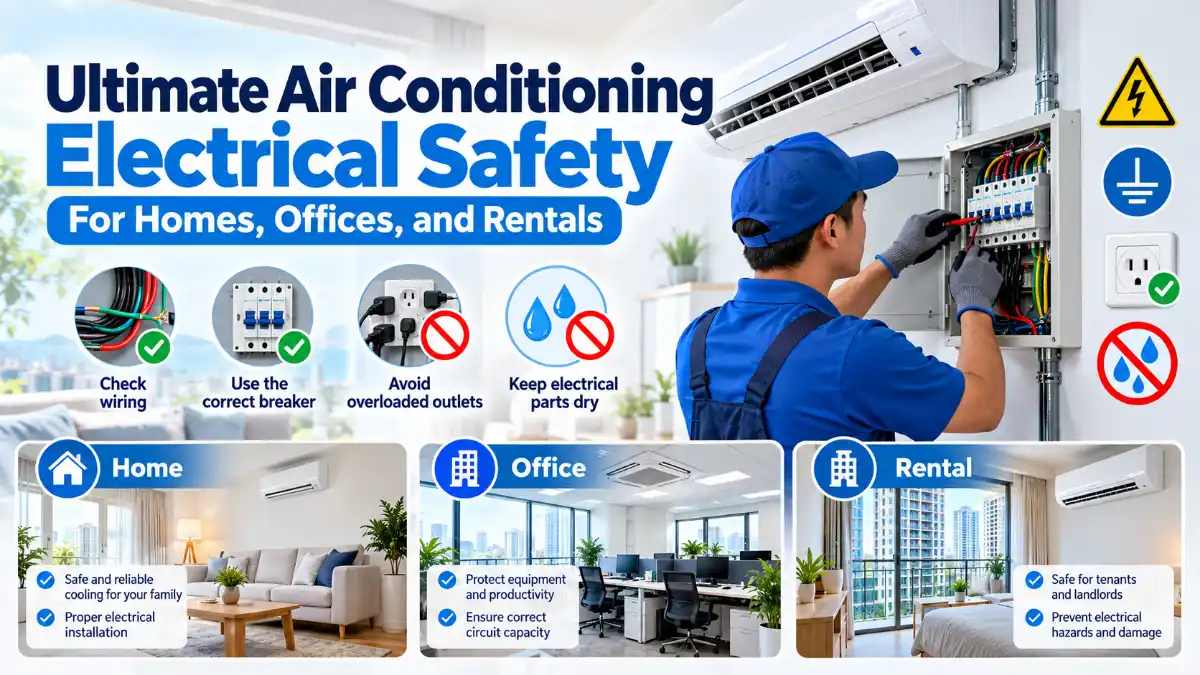
Air conditioners are essential for comfort in Cebu’s warm and humid climate. Whether installed in a family home, office, condominium, or rental property, a unit relies on proper maintenance. Regular inspections should be guided by air-con electrical safety Cebu.
While most people focus on cooling performance and electricity consumption, air-con electrical safety Cebu is equally important.
We address it alongside efficiency concerns.
Damaged wiring, overloaded circuits, loose connections, and incorrect installation can increase the risk of overheating. They also raise the risk of electric shock. These issues threaten air-con electrical safety Cebu.
Understanding basic air-con electrical safety can help property owners identify warning signs, arrange timely inspections and avoid unsafe practices.
This guide provides a practical air-con electrical safety checklist for homes, offices and rental properties in Cebu, including precautions before installation, common electrical problems and situations that require a qualified electrician.
1. Why Is Aircon Electrical Safety Important?
An air conditioner contains electrical components that power its compressor, fan motors, control boards and other operating systems.
Depending on its cooling capacity and design, the unit may place a significant demand on the property’s electrical supply.
If the wiring, protective devices or electrical connections are unsuitable, problems can develop during operation.
Potential hazards include:
- Overheated wires and connections
- Electrical short circuits
- Repeated circuit breaker trips
- Electric shock
- Damaged air-con components
- Unexpected equipment shutdown
- Electrical fires
Electrical safety should be considered during installation, replacement, servicing and routine property inspections.
A correctly installed air conditioner should have a suitable electrical supply, appropriate circuit protection and proper grounding in accordance with the manufacturer’s instructions and applicable electrical regulations.
2. Check Whether Your Aircon Has a Suitable Power Supply
Before installing or operating an air conditioner, verify that the available electrical supply matches the equipment’s requirements.
Aircon models can have different voltage, current and circuit specifications even when they have similar horsepower ratings.
For example, two 1.0 HP air conditioners may have different electrical requirements depending on their compressor technology and design.
Important Electrical Considerations
A qualified electrician or installer should assess:
- Supply voltage and frequency
- Aircon nameplate electrical ratings
- Available circuit capacity
- Existing electrical wiring
- Circuit breaker specifications
- Grounding arrangements
- Required protective devices
- Manufacturer installation instructions
Do not assume that an existing outlet or circuit is suitable simply because the air-con’s plug fits.
If the property has old wiring or an uncertain electrical history, arrange an assessment before connecting a new unit.
3. Use a Dedicated Aircon Electrical Circuit Where Required
Many air-conditioning manufacturers specify a dedicated electrical circuit for their equipment.
A dedicated circuit supplies the air conditioner without sharing the same branch circuit with unrelated appliances.
This helps avoid excessive loading and ensures that the circuit can be designed for the equipment’s electrical requirements.
Why Dedicated Circuits Matter
Sharing an unsuitable circuit with appliances such as refrigerators, electric kettles, heaters or other high-demand equipment can increase the risk of overloading.
Possible warning signs include:
- Circuit breakers frequently tripping
- Lights dimming when the compressor starts
- Overheated electrical connections
- Unusual electrical smells
- Unstable equipment operation
The correct circuit arrangement must follow the specific air-con model’s requirements and applicable Philippine electrical rules.
Important: Do not install a larger breaker to stop repeated tripping without identifying the cause. A circuit breaker must be correctly matched to the circuit design and equipment.
4. Inspect Electrical Wiring for Damage
Damaged or deteriorated electrical wiring can create serious hazards.
Wiring may become unsafe because of aging, poor installation, moisture exposure, physical damage or inappropriate repairs.
Warning Signs of Possible Wiring Problems
- Cracked or damaged cable insulation
- Exposed wires
- Burn marks around electrical fittings
- Discolored outlets
- Loose plugs
- Buzzing or crackling sounds
- Unusual heat near accessible connections
- A burning plastic smell
If you observe any of these signs, stop using the air-con when safe to do so and request an electrical inspection.
Do not remove covers, open electrical panels or attempt to repair damaged connections yourself.
Electrical testing and wiring replacement should be performed by appropriately qualified personnel.
5. Check the Circuit Breaker and Electrical Protection
Circuit breakers protect electrical circuits against certain overcurrent conditions.
A breaker that repeatedly trips may indicate an electrical fault, an overloaded circuit or a problem with the air-conditioning equipment.
What Property Owners Should Know
A circuit breaker should:
- Be appropriately selected for the circuit
- Be installed in a suitable electrical panel
- Be correctly identified where practical
- Operate without frequent unexplained trips
- Be inspected when damage or overheating is suspected
Never bypass a circuit breaker or replace it with a higher-rated device without proper electrical assessment.
Some installations also require residual-current or earth-leakage protection, depending on the applicable regulations and manufacturer instructions.
An electrician should determine the correct protective arrangements and check their operation.
6. Ensure the Aircon Is Properly Grounded
Grounding, also called earthing, is an important electrical safety measure.
A correctly designed grounding system provides a protective path for fault current and works with the required protective devices to reduce electric shock hazards.
Improper grounding can increase the risk of electric shock if an electrical fault energizes exposed metal parts.
Common Grounding Concerns
- Missing grounding conductors
- Incorrect electrical connections
- Damaged grounding wires
- Improperly modified plugs
- Older installations with uncertain grounding arrangements
Do not remove the grounding pin from a plug or attempt to connect a grounding wire to an unsuitable metal pipe.
A qualified electrician should verify grounding continuity and the suitability of the electrical installation.
7. Avoid Extension Cords and Overloaded Adapters
Air conditioners should be connected using an electrical arrangement approved for the specific equipment.
Ordinary extension cords and multi-plug adapters should not be used as substitutes for suitable permanent wiring.
Air conditioners may operate for many hours, and unsuitable extension cords can overheat under sustained electrical loads.
Unsafe Practices to Avoid
- Connecting an air-con through an ordinary extension cord
- Using multiple adapters from one outlet
- Plugging an extension cord into another extension cord
- Running power cords beneath carpets or furniture
- Using damaged or loosely fitting plugs
- Modifying an air-con plug to fit an unsuitable outlet
If the available electrical connection is too far from the unit, have a qualified electrician assess a suitable permanent solution.
8. Keep Electrical Components Away From Water
Air conditioners produce condensation during normal cooling.
This water should flow through the drainage system without reaching electrical components.
Blocked drain pipes, damaged hoses or incorrect installation may cause water to leak into walls, ceilings or areas containing electrical fittings.
Warning Signs of Water-Related Electrical Risks
- Water dripping near outlets
- Moisture around electrical fittings
- Wet cables or exposed connections
- Water entering an electrical panel
- Leaks above computers or office equipment
- Aircon water dripping onto extension cords
If water reaches electrical equipment, avoid touching affected components.
Stop using the air-con and arrange safe isolation of the electrical supply when necessary.
A qualified professional should assess the affected equipment before it is returned to service.
Related reading: Aircon Drainage Problems: How Poor Drainage Damages Walls, Ceilings, and Furniture.
9. Electrical Safety for Split-Type Air Conditioners
Split-type systems use separate indoor and outdoor units connected by refrigerant pipes and electrical wiring.
Electrical connections vary by model.
Some systems receive their main power supply through the outdoor unit, while others use a different manufacturer-specified arrangement.
Split-Type Aircon Safety Checklist
Before commissioning, qualified installers should verify:
- Correct power supply connection
- Appropriate electrical cable specifications
- Proper indoor-to-outdoor wiring
- Secure electrical terminals
- Suitable grounding
- Required protective devices
- Safe cable routing
- Properly fitted electrical covers
- No exposed conductors
- Successful electrical and operational testing
Electrical wiring must follow the unit’s wiring diagram rather than assumptions based on another brand or model.
The installer should also check that cables are protected from physical damage, sharp edges and unsuitable contact with piping.
10. Electrical Safety for Window-Type Air Conditioners
Window-type air conditioners combine the main cooling components into one unit.
Although installation may be simpler than a split-type system, electrical safety remains important.
Key Safety Considerations
- Use a suitable manufacturer-approved electrical connection.
- Confirm the outlet and circuit are properly rated.
- Avoid overloaded adapters.
- Inspect accessible power cords for damage.
- Ensure correct grounding.
- Keep water away from plugs and outlets.
- Maintain the installation according to the manufacturer’s instructions.
If a window-type air-con repeatedly trips its breaker or causes a plug or outlet to become unusually hot, stop using it and arrange an inspection.
Replacing the outlet alone may not solve an underlying wiring or equipment problem.
11. Aircon Electrical Safety Checklist for Homes
Homeowners should regularly observe their air-con for unusual operating conditions.
A basic visual inspection does not require opening the unit or electrical panel.
Home Aircon Safety Checklist
| Safety Item | Check |
|---|---|
| No visible damage to the power cord | ☐ |
| No burning smell during operation | ☐ |
| No unusual heat at accessible plugs or outlets | ☐ |
| No frequent circuit breaker trips | ☐ |
| No water leaking near electrical fittings | ☐ |
| No exposed or loose electrical wiring | ☐ |
| No overloaded adaptors or extension cords | ☐ |
| Aircon installed according to manufacturer requirements | ☐ |
| Routine servicing is arranged when needed | ☐ |
| Electrical concerns are assessed by a qualified professional | ☐ |
If you notice a warning sign, do not continue operating the equipment until the problem has been assessed.
12. Aircon Electrical Safety for Offices and Commercial Properties
Air conditioners in offices and commercial buildings often operate for longer periods than units used occasionally at home.
Some businesses also use several air conditioners simultaneously.
This makes electrical load planning and preventive maintenance particularly important.
Office Aircon Safety Considerations
Property managers and business owners should ensure that:
- Aircon installations are properly documented.
- Electrical circuits are suitable for the connected equipment.
- Electrical panels remain accessible to authorized personnel.
- Routine inspections are scheduled.
- Water leaks are addressed promptly.
- Staff know how to report unusual smells or equipment behavior.
- Maintenance and repair records are retained.
- Electrical faults are investigated before equipment is restarted.
Computers, printers, refrigerators and other workplace appliances can contribute to the building’s overall electrical demand.
Where multiple air conditioners are being added, a qualified electrician should assess whether the existing distribution system has adequate capacity.
13. Aircon Electrical Safety for Rental Properties
Rental properties require clear communication between landlords, tenants and property managers.
An air-con may be supplied by the property owner or installed by a tenant with permission.
Regardless of who purchased the equipment, electrical hazards should be reported and addressed promptly.
Responsibilities for Landlords
Landlords should arrange for the property’s electrical installation and owner-provided air-con equipment to be maintained in a safe condition.
They should also clarify maintenance responsibilities in the rental agreement.
Responsibilities for Tenants
Tenants should use air conditioners according to the manufacturer’s instructions, avoid unsafe electrical modifications and report problems such as:
- Repeated breaker trips
- Burning smells
- Damaged power cords
- Water leaks near electrical equipment
- Unusual electrical noises
- Suspected electric shock
Tenants should not modify fixed wiring or replace circuit breakers without proper authorization and qualified assistance.
Responsibilities for Property Managers
Property managers should coordinate inspections, document reported problems and arrange access for approved technicians when needed.
The precise legal and contractual responsibilities depend on applicable Philippine law, local requirements and the tenancy agreement.
14. Warning Signs Your Aircon May Have an Electrical Problem
Some electrical problems can develop gradually, while others require immediate attention.
The following symptoms should not be ignored.
| Warning Sign | Possible Concern | Recommended Action |
|---|---|---|
| Burning smell | Overheated wiring or components | Stop use and seek inspection |
| Repeated breaker trips | Overload, fault or equipment problem | Do not repeatedly reset |
| Crackling or buzzing | Loose or damaged electrical connection | Arrange urgent assessment |
| Hot or discoloured plug | Poor contact or overheating | Stop using the outlet |
| Electric shock or tingling | Possible grounding or electrical fault | Stop contact and seek urgent help |
| Water near electrical fittings | Shock or short-circuit hazard | Keep clear and isolate safely |
| Aircon repeatedly shuts down | Electrical or control system fault | Request diagnosis |
| Visible sparks or smoke | Serious electrical hazard | Keep clear and seek emergency assistance |
If smoke or fire is present, leave the affected area and contact emergency services. Do not touch the equipment or attempt to extinguish an electrical fire with water.
15. What to Do if Your Aircon Trips the Circuit Breaker
A circuit breaker may trip because of an overloaded circuit, short circuit, earth fault or problem within the air-con.
It is important not to assume that the breaker itself is defective.
Safe Steps to Follow
- Stop using the air conditioner.
- Keep other people away if there are signs of damage, water, smoke or burning.
- Avoid repeatedly resetting the breaker.
- Check for visible warning signs without opening electrical equipment.
- Contact a qualified electrician or air-con technician to identify the cause.
Repeated breaker tripping is a warning sign that should be investigated.
Installing a larger breaker without confirming the circuit’s suitability can increase the risk of overheating.
16. Why Professional Aircon Installation Matters
Correct installation helps protect both the air conditioner and the property.
Professional installation involves more than mounting the equipment.
Depending on the system, the work may include:
- Confirming electrical supply requirements
- Assessing circuit suitability
- Providing correct wiring arrangements
- Checking grounding
- Installing required protective devices
- Connecting indoor and outdoor components
- Securing electrical covers
- Inspecting drainage
- Conducting final operating tests
Electrical work should be performed by appropriately qualified personnel in accordance with the applicable Philippine Electrical Code requirements and the manufacturer’s instructions.
A poorly installed air conditioner may experience recurring faults, reduced reliability or unsafe operating conditions.
17. How Often Should Aircon Electrical Safety Be Checked?
There is no single inspection interval suitable for every property.
The appropriate frequency depends on the equipment, manufacturer’s recommendations, operating conditions and condition of the electrical installation.
For Residential Properties
Look for visible warning signs during normal use and arrange professional inspection whenever electrical problems appear.
Include basic electrical checks during routine air-con servicing where appropriate.
For Offices
Develop a maintenance schedule based on equipment usage, site conditions and the property’s electrical safety program.
For Rental Properties
Consider arranging inspections before new occupancy, after major electrical alterations and whenever tenants report electrical concerns.
Scheduled servicing provides an opportunity to identify developing problems before they become more serious.
18. Aircon Electrical Safety in Cebu’s Climate
Cebu’s warm and humid environment can introduce additional maintenance concerns.
Outdoor condenser units may be exposed to rain, wind-driven moisture and, in coastal areas, salt-laden air.
These conditions can contribute to corrosion and deterioration of exposed materials over time.
Important Considerations in Cebu
- Inspect outdoor equipment for visible damage.
- Maintain proper drainage.
- Keep electrical components protected from water.
- Arrange inspection after suspected storm or flood damage.
- Use materials suitable for the installation environment.
- Check outdoor mounting and exposed cable protection.
- Address corrosion concerns promptly.
For properties near coastal areas, maintenance planning should account for local exposure conditions.
19. Aircon Electrical Safety Inspection in Cebu
Whether you manage a family home, office, condominium or rental property, electrical safety should form part of your air-con maintenance planning.
At Cebu Aircon Services, we encourage property owners to recognize warning signs and arrange appropriate professional inspections rather than attempting unsafe electrical repairs.
For air-con installations in Cebu City, Mandaue, Lapu-Lapu, Talisay and nearby communities, the equipment’s electrical requirements should be confirmed before installation or replacement.
If an air-con develops unusual electrical symptoms, a qualified professional can help determine whether the issue involves the appliance, wiring, protective devices or another part of the electrical system.
Frequently Asked Questions
Does an air-con need its own circuit breaker?
Many air conditioners require a dedicated electrical circuit and appropriate circuit protection. The exact arrangement depends on the air-con model, its electrical ratings and applicable wiring requirements. A qualified electrician should verify the installation.
Is it safe to plug an air-con into an extension cord?
Ordinary extension cords should not be used as a substitute for an appropriate permanent air-con power connection. Follow the manufacturer’s instructions and have a suitable electrical connection installed where necessary.
Why does my air-con keep tripping the breaker?
Possible causes include circuit overload, wiring faults, compressor or motor problems, insulation faults and other electrical issues. Avoid repeatedly resetting the breaker and arrange professional diagnosis.
Can poor grounding damage an air-con?
Improper grounding can create electric shock hazards and may contribute to unsafe operation under fault conditions. Correct grounding and protective devices should be verified by qualified personnel.
Can an air-con cause an electrical fire?
Electrical fires can occur when equipment or wiring develops serious faults, overheats or is installed incorrectly. Proper installation, suitable circuit protection and timely repairs help reduce risk.
What should I do if my air-con smells like burning plastic?
Switch it off if safe to do so, keep clear of the affected equipment and arrange urgent professional inspection. If smoke or fire is present, evacuate and contact emergency services.
Should landlords inspect air-con electrical connections?
Landlords and property managers should ensure that owner-provided equipment and the property’s electrical installation are properly maintained, subject to applicable requirements and lease arrangements.
Can water leaking from an air-con cause electrical problems?
Yes. Water reaching electrical connections, outlets or appliances may create shock or short-circuit hazards. Stop using the affected equipment and have the situation assessed safely.
Does inverter air-con require different electrical wiring?
Electrical specifications vary between inverter and non-inverter models. The correct wiring, protective devices and power connection should always follow the specific manufacturer’s requirements.
Can an air-con technician replace a circuit breaker?
Fixed electrical installation work should be performed only by persons who hold the qualifications and authorizations required for that work. Breaker replacement should follow a proper diagnosis and applicable electrical requirements.
Final Thoughts
Aircon electrical safety is an important part of protecting your property, equipment and occupants.
Damaged wiring, unsuitable circuit protection, poor grounding and water exposure should never be ignored.
Regular visual checks, professional servicing and correct installation practices can help reduce the risk of electrical problems.
For homes, offices and rental properties in Cebu, understanding the warning signs and knowing when to call a qualified professional is essential.
Concerned About Your Aircon’s Electrical Safety?
Contact Cebu Aircon Services to discuss your air-conditioning concerns and arrange an appropriate assessment. Electrical faults and fixed wiring work should be referred to a qualified electrician when required.
Proper diagnosis and timely maintenance can help support safe, reliable air-con operation.