
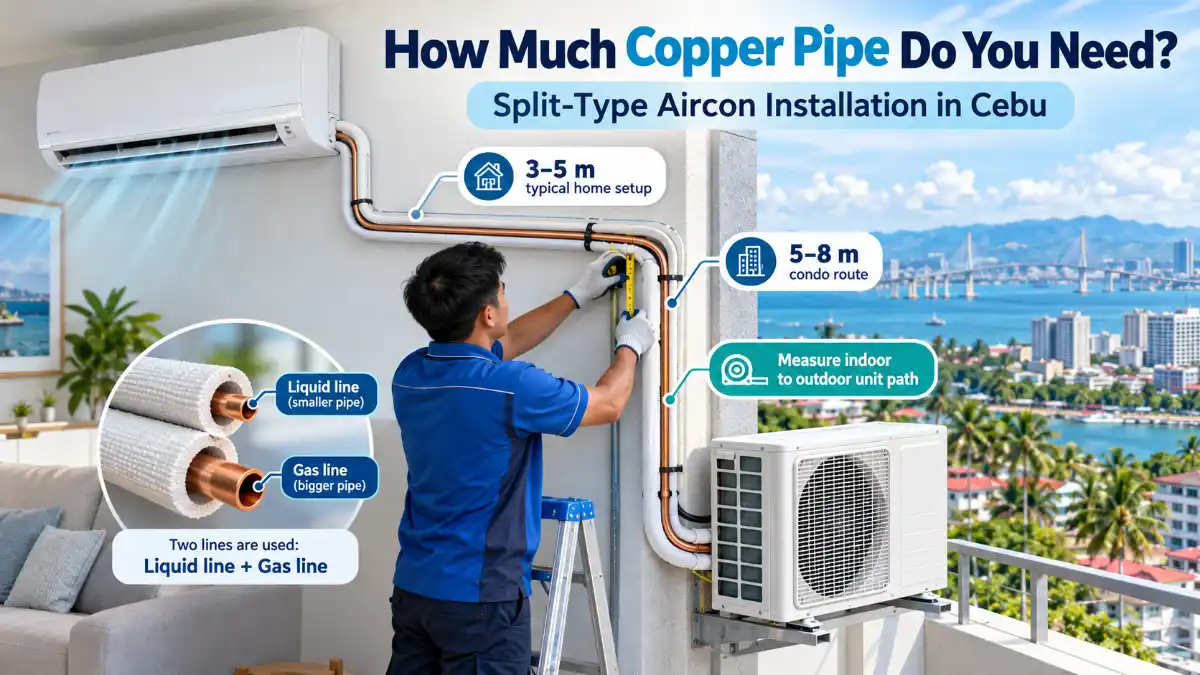
Installing a split-type air conditioner requires more than mounting the indoor unit and outdoor condenser. One important component is the copper piping that connects both units and allows refrigerant to circulate throughout the cooling system.
If you are planning a split-type aircon installation in Cebu, you may be wondering how many metres of copper pipe you need, whether a standard installation package includes enough piping, and how additional pipe length affects the total cost.
The answer depends on the distance between the indoor and outdoor units, the installation layout, the aircon model and the manufacturer’s requirements.
This guide explains how copper piping works, how to estimate the required length, common pipe sizes and what to discuss with your technician before installation.
1. What Is Copper Piping in a Split-Type Aircon?
Copper piping is used to carry refrigerant between the indoor and outdoor units of a split-type air conditioner.
Most conventional single-split systems use two refrigerant lines:
- Liquid line: Carries high-pressure refrigerant from the outdoor unit towards the indoor unit during normal cooling operation.
- Gas or suction line: Returns low-pressure refrigerant vapour from the indoor unit towards the compressor.
These pipes work together to transfer heat from inside the room to the outdoor environment.
Copper is widely used because it can withstand appropriate refrigerant operating pressures, transfer heat effectively and be formed into the routing required for aircon installation.
However, the copper tubing must have the correct diameter, wall thickness, cleanliness and pressure rating for the equipment.
2. How Many Metres of Copper Pipe Are Usually Needed?
For a straightforward residential split-type aircon installation, a route of approximately 3 to 5 metres between the indoor and outdoor units is a useful planning example.
However, this is not a universal standard or a guaranteed amount supplied with every air conditioner.
The actual pipe requirement depends on the installation.
Example Copper Pipe Requirements
| Installation Situation | Illustrative Pipe Route Length |
|---|---|
| Bedroom with nearby outdoor unit | 3 metres |
| Small apartment with condenser outside the wall | 3–4 metres |
| Studio apartment with a more distant condenser | 4–6 metres |
| Condo with designated outdoor condenser area | 5–8 metres |
| Installation requiring a longer pipe route | 8 metres or more |
These figures are examples for budgeting, not manufacturer-approved limits. The required route must satisfy the specific model’s minimum and maximum pipe length, permitted height difference and other installation conditions.
Important: Two Copper Pipes Are Needed
A split-type aircon normally uses one liquid line and one gas line along the same route.
For example, if the required pipe route is 4 metres:
- Liquid copper line: approximately 4 metres
- Gas copper line: approximately 4 metres
- Total individual copper tubing: approximately 8 metres
An installation quotation may describe this as a 4-metre pipe set, rather than 8 metres of individual copper tubing.
Always confirm how the installer measures and charges for refrigerant piping.
3. How to Measure Copper Pipe Length for Aircon Installation
You can estimate the required piping length before the technician visits your property.
The important measurement is the intended route between the indoor and outdoor refrigerant connections, not simply the straight-line distance between the units.
Step 1: Identify the Indoor Unit Location
Choose a possible location for your split-type aircon.
Make sure the wall provides suitable access for installation, airflow and future maintenance.
Step 2: Locate the Outdoor Condenser
Determine where the outdoor unit can be installed safely.
For houses, this may be a suitable exterior wall or ground-level location.
For condominiums, the outdoor unit may need to be placed in a designated condenser area.
Step 3: Trace the Pipe Route
Estimate the complete path that the pipes will follow.
Consider:
- Horizontal distance along the wall
- Vertical distance between units
- Wall penetration and routing around structural features
- Pipe bends and connection allowances
- Any building-approved concealed pipe routes
The shortest straight-line measurement is not always the actual installation length.
Step 4: Confirm the Measurement With a Technician
A professional installer should inspect the route and determine the final piping requirement.
The measurement must also comply with the equipment manufacturer’s installation instructions.
Example Calculation
Suppose the proposed route includes:
| Pipe Route Section | Length |
|---|---|
| Horizontal route | 2.0 m |
| Vertical section | 1.5 m |
| Routing and connection allowance | 0.5 m |
| Estimated one-way pipe route | 4.0 m |
For this example, the installation requires approximately 4 metres of each copper line, or 8 metres of individual copper tubing.
This is a preliminary estimate only. Actual allowances, permitted bends and pipe lengths must be confirmed during installation.
4. What Copper Pipe Sizes Are Used for Split-Type Aircon?
Copper pipe diameter depends on the air conditioner’s model, capacity and refrigerant system design.
Common residential pipe outside diameters include:
| Copper Pipe Size | Metric Equivalent | Typical Application |
|---|---|---|
| 1/4 inch | 6.35 mm | Liquid line on many residential units |
| 3/8 inch | 9.52 mm | Gas line on some smaller models |
| 1/2 inch | 12.70 mm | Gas line on certain models |
| 5/8 inch | 15.88 mm | Gas line on some larger-capacity units |
These are common nominal sizes, not a universal sizing chart based on horsepower.
For example, a particular residential aircon may use a 1/4-inch liquid pipe and a 3/8-inch gas pipe, while another model may require a different combination.
Always check the manufacturer’s specifications before purchasing piping.
Do not select copper pipe diameter based on horsepower alone. Incorrect piping can affect refrigerant flow, system operation and equipment reliability.
5. Does Every Split-Type Aircon Include 3 Metres of Copper Pipe?
No. The contents of aircon installation packages vary depending on the brand, retailer, installer and promotional offer.
Some packages include a specified length of copper piping and insulation. Others provide installation labour separately and charge for the required materials.
Before purchasing an aircon, ask whether the quotation includes:
- Copper liquid and gas pipes
- Pipe insulation
- Refrigerant pipe fittings
- Drainage hose or piping
- Electrical and communication cables
- Outdoor unit mounting brackets
- Wall drilling
- Standard installation labour
- Additional piping charges
If the package includes 3 metres of piping but your installation requires 5 metres, the technician may charge for the additional 2 metres of pipe set and associated materials.
Make sure this is clearly stated in your quotation.
6. How Much Does Additional Copper Piping Cost in Cebu?
The cost of additional refrigerant piping depends on several factors.
These include copper tube diameter, wall thickness, quality, insulation, material availability and the installation work involved.
A longer pipe route may also require additional electrical cables, drainage materials, wall trunking or labour.
Factors That Affect Copper Piping Costs
| Cost Factor | Why It Matters |
|---|---|
| Copper diameter | Larger pipes generally require more material |
| Copper quality and specification | Refrigeration-grade tubing must suit the system |
| Installation distance | Longer routes require more tubing |
| Pipe insulation | Both refrigerant lines may require suitable insulation |
| Installation difficulty | Concealed routes or difficult access increase labour |
| Outdoor condenser position | Greater separation may increase material requirements |
| Building restrictions | Condo rules may require approved routing |
| Additional refrigerant | May be required beyond the manufacturer’s specified precharged length |
When comparing installation quotations in Cebu, request the price per additional metre of pipe set, including any associated insulation and labour.
This provides a clearer comparison than looking at copper material prices alone.
7. Can Copper Pipes Be Too Long?
Yes. Every split-type air conditioner has manufacturer-defined refrigerant piping limits.
These can include:
- Minimum piping length
- Maximum allowable piping length
- Maximum height difference between units
- Refrigerant charge allowances
- Permitted pipe configurations
- Required pipe diameters
For example, a Daikin residential installation manual specifies a minimum piping length of 2.5 metres and a maximum of 15 metres for a particular model class.
Other models can have different limits.
Using a longer route than permitted can affect system operation and may place the installation outside the manufacturer’s approved specifications.
An installer should always verify the exact model’s requirements before completing a long pipe run.
8. Is Shorter Copper Piping Always Better?
A shorter pipe route can reduce material requirements and installation complexity.
However, the shortest possible distance is not necessarily the best installation.
Some aircon manufacturers specify a minimum pipe length to help manage vibration or noise transmission.
For this reason, installers should not cut refrigerant pipes to the shortest possible measurement without checking the manual.
A good installation balances:
- Manufacturer-approved piping length
- Suitable condenser placement
- Proper ventilation
- Drainage requirements
- Maintenance access
- Safe mounting positions
- Practical routing
The goal is to use an appropriate pipe route rather than simply minimising copper consumption.
9. Does Longer Copper Piping Affect Aircon Cooling?
Longer refrigerant piping can affect system performance, particularly if the installation exceeds manufacturer limits or uses the wrong pipe diameter.
Potential problems include:
- Excessive refrigerant pressure losses
- Reduced cooling performance
- Improper refrigerant charge
- Increased installation complexity
- Additional opportunities for installation defects
Within the approved installation range, manufacturers account for permissible pipe lengths and height differences.
Proper installation, leak testing, evacuation and refrigerant charging are essential.
A longer approved pipe route does not automatically mean the aircon will perform poorly.
10. Does Longer Piping Require Additional Refrigerant?
Sometimes.
Many split-type air conditioners leave the factory with a specified refrigerant charge that accommodates a defined length of connected piping.
When the installation exceeds that precharged allowance, additional refrigerant may be required.
The required amount is model-specific and must follow the manufacturer’s instructions.
For example, some installation manuals specify additional refrigerant in grams per metre beyond a defined pipe length.
This does not mean every installation over 3 metres needs additional refrigerant.
Important: Additional refrigerant should only be added according to the manufacturer’s specifications and after the required installation checks. Overcharging or undercharging can damage the system or reduce efficiency.
Refrigerant handling should be performed by appropriately trained technicians using suitable equipment.
11. Copper Pipe Requirements for Condo Installations in Cebu
Condominiums often have more complicated piping arrangements than detached houses.
A condo’s designated outdoor condenser location may be several metres away from the indoor unit.
Some buildings also require refrigerant pipes to pass through approved service routes or ceiling spaces.
Before installation, check:
- Approved indoor unit placement
- Outdoor condenser location
- Maximum permitted pipe route
- Allowed wall openings
- Building-approved pipe concealment
- Condensate drainage arrangements
- Electrical and safety requirements
- Access for future repairs
For condos in Cebu City, Mandaue or Lapu-Lapu, confirm the building’s installation rules before purchasing an aircon or requesting additional copper pipe materials.
12. Why Copper Pipe Insulation Matters
Copper refrigerant pipes should be insulated according to the aircon manufacturer’s requirements.
Proper insulation helps limit unwanted heat exchange and prevents moisture from condensing on cold pipe surfaces.
Poor or damaged insulation may contribute to:
- Water dripping from exposed pipes
- Damp ceilings or walls
- Reduced cooling efficiency
- Moisture damage around concealed piping
The correct insulation type and thickness depend on the system, refrigerant pipe size and installation conditions.
Cebu’s humid climate makes proper protection against condensation particularly important.
13. Can You Reuse Existing Copper Piping?
Sometimes, but only when the piping is suitable for the new air-conditioning system.
Reusing old copper lines without inspection can introduce problems involving contamination, incorrect pipe sizes, incompatible pressure ratings or damaged fittings.
Before reusing refrigerant piping, a qualified technician should assess:
- Pipe diameter and wall thickness
- Existing refrigerant system compatibility
- Piping condition
- Signs of corrosion or physical damage
- Contamination or moisture
- Pipe length and routing
- Manufacturer requirements for reuse
Some manufacturers prohibit or restrict reuse under particular conditions.
Replacing unsuitable piping may be necessary to protect the new system.
14. Common Copper Pipe Installation Mistakes
Incorrect refrigerant piping can affect aircon performance and reliability.
Using the Wrong Pipe Diameter
Copper tubing must match the model’s refrigerant connection requirements.
Excessive Pipe Bending
Sharp bends can restrict refrigerant flow or damage the tubing.
Poor Flared Connections
Improperly prepared connections can cause refrigerant leaks.
Inadequate Insulation
Missing or damaged insulation can lead to condensation and unwanted heat transfer.
Exceeding Maximum Pipe Length
An installation outside the manufacturer’s permitted range may affect performance or reliability.
Skipping Leak Testing and Evacuation
Air and moisture should be properly removed from the refrigerant circuit using the manufacturer’s specified procedure.
These steps should be performed by trained technicians before the system is commissioned.
15. Copper Piping Checklist Before Aircon Installation
Use this checklist when discussing your installation with a technician.
| Checklist Item | Check |
|---|---|
| Confirm the exact aircon model | ☐ |
| Verify manufacturer-approved pipe diameters | ☐ |
| Identify indoor and outdoor unit locations | ☐ |
| Measure the proposed refrigerant piping route | ☐ |
| Check minimum and maximum pipe length | ☐ |
| Confirm allowable height difference | ☐ |
| Ask how many metres are included in the quotation | ☐ |
| Confirm the price of additional pipe sets | ☐ |
| Check insulation specifications | ☐ |
| Verify building or condo installation rules | ☐ |
| Confirm refrigerant charging requirements | ☐ |
| Request proper testing and commissioning | ☐ |
16. Professional Split-Type Aircon Installation in Cebu
Choosing the correct copper piping is an important part of a reliable aircon installation.
Whether you are installing a unit in a small bedroom, condominium, apartment, office or commercial property, the piping layout should be planned according to the equipment specifications and site conditions.
At Cebu Aircon Services, we understand the importance of proper installation planning, including refrigerant piping requirements, indoor and outdoor unit placement and practical access considerations.
If you are planning to install a split-type air conditioner in Cebu City, Mandaue, Lapu-Lapu, Talisay or a nearby area, consider arranging a professional assessment before purchasing additional materials.
A properly planned installation can help prevent unexpected costs and protect the air conditioner’s long-term performance.
Frequently Asked Questions
How many metres of copper pipe do I need for a 1 HP split-type aircon?
The required length depends on the distance and routing between the indoor and outdoor units, not simply the horsepower. A 3–5 metre route is one possible residential installation scenario, but the final measurement must comply with the model’s specifications.
Is 3 metres of copper piping enough for a split-type aircon?
It may be enough when the outdoor condenser is installed close to the indoor unit. However, some installations require longer piping, and some models have specific minimum-length requirements.
How much copper tubing is needed for a 5-metre pipe run?
A typical single-split system needs approximately 5 metres of liquid-line tubing and 5 metres of gas-line tubing, or 10 metres of individual copper pipe. This is generally referred to as a 5-metre pipe set.
Can I use 10 metres of copper pipe for a split-type aircon?
Possibly, provided the model supports a 10-metre refrigerant pipe route and the installation meets its height difference, pipe size and refrigerant requirements.
Does longer copper pipe increase electricity consumption?
Longer piping can introduce additional pressure losses, but the effect depends on the system design and installation. A correctly installed pipe run within manufacturer limits should not be treated as automatically inefficient.
What copper pipe sizes are used for split-type aircon?
Common sizes include 1/4 inch, 3/8 inch, 1/2 inch and 5/8 inch outside diameter. The correct liquid and gas pipe sizes depend on the specific aircon model.
Is additional copper piping included in aircon installation packages?
Not always. Installation packages differ by supplier and installer. Check the included pipe length and the charge for additional piping before confirming the work.
Can I purchase my own copper pipe for installation?
Some installers may allow customer-supplied materials, but the tubing must match the manufacturer’s requirements. Confirm specifications and any warranty implications with the installer before buying.
Can old aircon copper pipes be reused?
Reuse may be possible if the existing piping meets the new model’s requirements and passes the necessary inspection. The manufacturer must permit reuse, and contaminated or damaged pipes should not be retained.
Final Thoughts
The amount of copper pipe needed for split-type aircon installation depends on the actual pipe route, equipment specifications and property layout.
Although 3–5 metres is a useful example for straightforward residential installations, there is no universal length that suits every air conditioner.
Before installation, confirm the pipe diameters, approved piping limits, included materials and potential additional charges.
Planning a Split-Type Aircon Installation in Cebu?
Contact Cebu Aircon Services to discuss your installation requirements and arrange an assessment of the proposed piping route.
A professional evaluation can help determine the correct materials and avoid unnecessary installation expenses.