
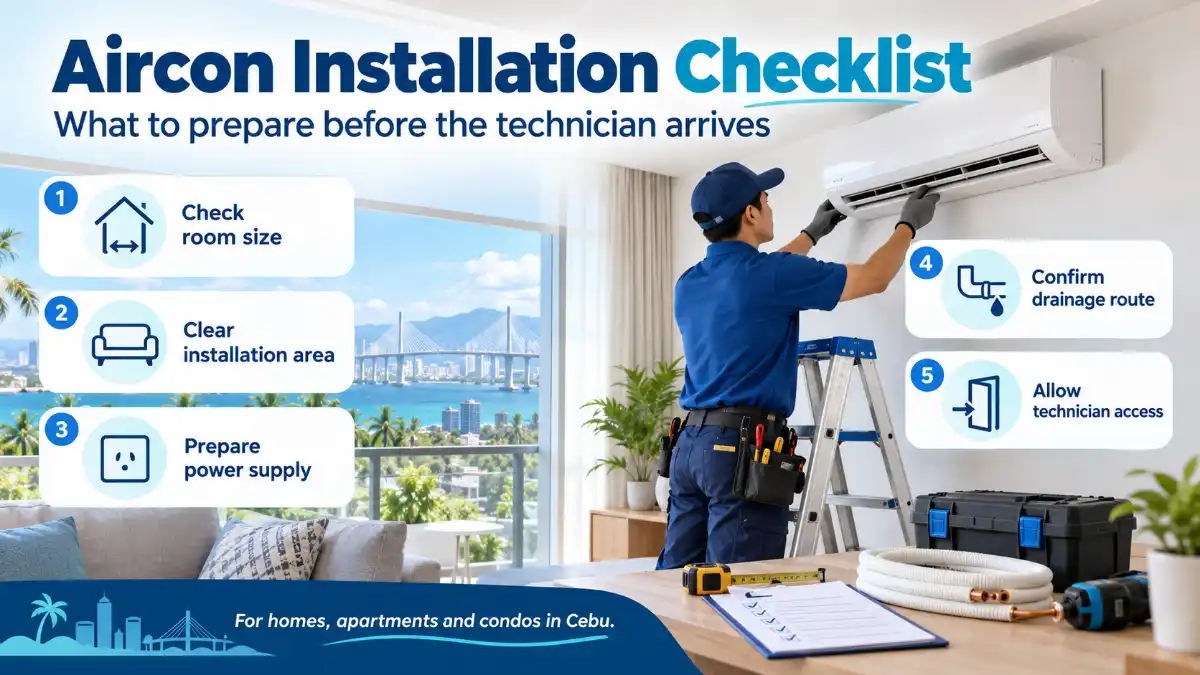
Installing a new air conditioner is an important step towards creating a cooler and more comfortable home or workplace. However, successful installation involves more than choosing an aircon and booking a technician.
Preparing the room, checking electrical requirements and understanding where the unit will be installed can help prevent delays, unexpected expenses and installation problems.
Whether you live in a house, apartment or condominium in Cebu, a little preparation before installation day can make the entire process easier.
This aircon installation checklist explains what homeowners, tenants and business owners should prepare before a technician arrives, including room access, aircon placement, electrical considerations and important questions to ask.
1. Confirm the Right Aircon Size for Your Room
Before scheduling installation, make sure your air conditioner has enough cooling capacity for the space.
Air conditioners are commonly classified by horsepower (HP) in the Philippines. Choosing the correct size helps maintain comfortable indoor temperatures without unnecessary energy consumption.
General Aircon Horsepower Guide
| Room Size | Suggested Aircon Capacity | Common Application |
|---|---|---|
| 6–11 sqm | 0.5 HP | Small bedroom |
| 12–17 sqm | 0.75 HP | Standard bedroom |
| 18–22 sqm | 1.0 HP | Larger bedroom or home office |
| 23–27 sqm | 1.5 HP | Studio apartment or living area |
| 28–40 sqm | 2.0 HP | Larger room or open-plan space |
These are approximate starting points rather than fixed requirements. Sunlight exposure, insulation, ceiling height, occupancy and heat-producing appliances can affect the capacity needed.
For rooms with large windows or strong afternoon sunlight, consider asking a technician to assess the cooling requirements before purchasing your aircon.
Related reading: How to Choose an Aircon for a Small Bedroom, Studio, or Condo in Cebu.
2. Decide Where the Indoor Aircon Unit Should Be Installed
Choosing a suitable location for the indoor unit is one of the most important parts of installation planning.
For split-type air conditioners, the indoor unit should be positioned where it can distribute cool air throughout the room while remaining accessible for maintenance.
Before the technician arrives, identify one or two possible installation locations.
What Makes a Good Indoor Unit Location?
Consider the following:
- An unobstructed area for proper airflow
- A stable wall capable of supporting the equipment
- Sufficient clearance around the unit
- Convenient access for future cleaning
- A suitable route for refrigerant piping and drainage
- A position that does not direct cold air continuously towards the bed or seating area
Avoid placing the aircon where cabinets, curtains or large furniture could restrict airflow.
The technician should confirm the final mounting location based on the manufacturer’s installation specifications.
3. Check the Outdoor Condenser Location
For split-type air conditioning systems, the outdoor condenser is an essential part of the installation.
The outdoor unit releases heat collected from the indoor space, so it needs adequate ventilation and a secure mounting position.
A poorly selected location may affect performance, increase vibration or make future servicing difficult.
Things to Check Before Installation
- Is there an approved location for the outdoor unit?
- Is the mounting surface strong enough?
- Will the condenser have enough ventilation?
- Can technicians safely access the unit for maintenance?
- Is there enough space around the equipment?
- Can refrigerant pipes reach the planned location within the manufacturer’s limits?
- Will the installation comply with the property’s rules?
Outdoor units should not be placed in completely enclosed spaces without adequate ventilation.
For condominiums, use only designated or approved condenser locations.
If your property does not have a suitable outdoor area, discuss alternative installation arrangements with the technician before buying the equipment.
4. Confirm Electrical Requirements Before Installation
Air conditioners require an appropriate electrical supply to operate safely.
The electrical requirements depend on the unit’s cooling capacity, electrical rating and manufacturer’s specifications.
Some properties already have a suitable dedicated circuit, while others may need electrical work before installation can proceed.
Electrical Preparation Checklist
Before the scheduled visit, confirm:
- Whether a dedicated aircon circuit is available
- Whether the electrical supply matches the equipment
- Whether the circuit breaker is appropriately rated
- Whether proper grounding is provided
- Whether electrical wiring is in good condition
- Whether additional electrical work is necessary
Never assume that an existing wall outlet is suitable for a newly purchased air conditioner.
Avoid using ordinary extension cords or overloaded adaptors to power the unit.
Electrical connections, protective devices and wiring requirements should be checked by qualified personnel according to applicable electrical standards and the manufacturer’s instructions.
Important: Homeowners should not attempt to modify electrical wiring or install circuit breakers themselves unless properly qualified.
5. Check Whether Wall Drilling Is Allowed
Split-type aircon installation commonly requires an opening through which refrigerant piping, electrical cables and drainage can pass.
Before the technician arrives, determine whether drilling is permitted in the proposed location.
This is particularly important for:
- Condominium units
- Rental apartments
- Commercial offices
- Newly renovated homes
- Properties with structural restrictions
If you are renting, obtain approval from the property owner before allowing permanent modifications.
For condominium residents, confirm whether the building requires approved drilling locations or an accredited installer.
Some buildings may have prepared aircon pipe openings, making additional drilling unnecessary.
6. Prepare a Proper Drainage Route
Air conditioners remove moisture from indoor air during cooling. This moisture becomes condensate water that must be safely drained.
For split-type systems, the installer usually connects the indoor unit to a drainage pipe or hose.
Poor drainage can result in water dripping indoors, damp walls or damage to furniture.
What Should Be Checked?
Before installation, ask:
- Where will condensate water drain?
- Is there an approved drainage connection?
- Will the drain line have the required slope?
- Does the building permit the proposed drain route?
- Is a condensate pump necessary?
The technician should determine the correct drainage arrangement.
In condominiums, drainage must comply with property management requirements. Water should not be discharged onto neighbouring balconies, walkways or other unsuitable areas.
7. Clear the Installation Area
One of the simplest ways to prepare is to provide enough working space.
Aircon technicians may need to use ladders, drills, mounting brackets and other installation tools.
A crowded room can make installation more difficult and increase the risk of accidental damage.
Before the Technician Arrives
- Move furniture away from the planned installation wall.
- Remove decorations, picture frames and fragile items.
- Clear the route between the entrance and installation area.
- Cover nearby furniture or electronics to protect them from dust.
- Keep children and pets away from the work zone.
- Provide safe access to the outdoor unit location.
- Ensure the room has sufficient lighting.
You do not need to empty the entire room. Providing a practical working area is normally enough.
If heavy furniture cannot be moved, inform the installation team before the appointment.
8. Prepare the Aircon Unit and Installation Accessories
If you purchased your air conditioner separately from the installation service, check that the equipment is ready for the technician.
Inspect the packaging for visible damage and confirm that the delivered model matches your order.
Items to Prepare
- Indoor aircon unit
- Outdoor condenser, if applicable
- Remote control
- Installation manual
- Warranty documents
- Manufacturer-supplied accessories
- Proof of purchase
- Any separately purchased installation materials
Some installation packages include standard piping, brackets and labour, while others charge separately for additional materials.
Confirm what is included in your quotation before the scheduled installation.
Do not open refrigerant connections, disassemble the equipment or perform electrical work yourself.
9. Confirm What Is Included in the Installation Quotation
Aircon installation costs can vary depending on the unit type, property layout and additional materials required.
For example, installing a split-type aircon in a bedroom with a nearby outdoor condenser location may be less complicated than installing one in a high-rise condominium.
Common Installation Cost Factors
| Installation Item | Why It Matters |
|---|---|
| Standard installation labour | Covers agreed installation work |
| Copper piping | Connects the indoor and outdoor units |
| Pipe insulation | Helps prevent unwanted heat gain and condensation |
| Drainage materials | Carries condensate water away safely |
| Condenser brackets | Supports the outdoor unit where approved |
| Additional electrical work | May be needed for a suitable power supply |
| Extra pipe length | Longer installation routes may increase material costs |
| Wall drilling | Depends on wall construction and access |
| Removal of an existing unit | May be quoted separately |
| Difficult-access work | May require additional equipment or safety arrangements |
Ask for a written quotation describing labour, included materials, additional charges and any applicable workmanship warranty.
This helps prevent misunderstandings after installation.
10. Check Condo or Property Management Requirements
Many Cebu condominiums have specific rules for air-conditioning installation.
These requirements are intended to protect the building, maintain safety and prevent problems involving drainage, electrical connections or outdoor unit placement.
Before booking a technician, confirm whether you need:
- Property management approval
- An installation work permit
- An accredited contractor
- An approved installation schedule
- A designated service elevator
- A security entry pass
- Approved condenser placement
- Approved drilling and piping routes
For residents in Cebu City, Mandaue and Lapu-Lapu, building requirements may differ from one condominium development to another.
Contact your property management office to confirm what documentation is necessary.
Obtaining approval in advance can prevent your scheduled installation from being postponed.
11. Arrange Access and Parking for the Technician
Aircon installation teams often bring tools, ladders, equipment and installation materials.
Easy access to the property helps the technicians complete their work efficiently.
For houses, make sure the entrance and relevant work areas are accessible.
For condominiums and commercial buildings, check visitor registration procedures, loading areas and parking restrictions.
If your property has security checkpoints, provide the technician with the necessary arrival instructions before the appointment.
You should also ensure that an authorised adult is available to confirm the installation position and discuss any unexpected issues.
12. Ask About the Expected Installation Process
Knowing what will happen during the installation can help you prepare appropriately.
Although procedures vary by aircon type and property conditions, a typical split-type installation may involve:
- Inspecting the planned indoor and outdoor locations
- Confirming mounting clearances and access
- Installing the indoor mounting plate
- Preparing approved pipe and drain openings
- Mounting the outdoor condenser securely
- Connecting refrigerant pipes and drainage
- Completing the required electrical connections
- Performing refrigerant piping checks and evacuation
- Conducting final inspections
- Testing cooling, airflow and drainage
These technical procedures must be performed by qualified installers.
Ask the technician to explain any additional work required before proceeding with changes that may affect the quotation.
13. What Should You Check After Installation?
Do not consider an installation complete simply because the aircon switches on.
The technician should demonstrate that the system is functioning correctly and explain basic operating instructions.
Post-Installation Inspection
Check that:
- The aircon starts and responds to the remote control.
- Cool air flows from the indoor unit.
- The indoor and outdoor units are securely mounted.
- There is no obvious abnormal vibration or rattling.
- Condensate drains through the intended route.
- No water leaks are visible.
- Installation debris and packaging have been cleared.
- The technician explains basic cleaning and operation.
- Warranty and service information is provided.
The installer should also complete the required technical tests, including checks of refrigerant connections and electrical safety, in accordance with the manufacturer’s instructions.
For inverter units, ask the technician to explain recommended operating settings and routine maintenance.
14. Common Aircon Installation Mistakes to Avoid
Even a high-quality air conditioner may perform poorly if it is installed incorrectly.
Several avoidable mistakes can affect safety, comfort and long-term reliability.
Choosing the Wrong Aircon Size
A unit that is too small may struggle to cool the room, while an oversized system may provide poor humidity control.
Installing the Indoor Unit in a Restricted Space
Insufficient clearance can limit airflow and make future maintenance difficult.
Poor Outdoor Condenser Ventilation
Restricted airflow around the outdoor unit can affect heat rejection and cooling efficiency.
Incorrect Drainage Installation
An improperly installed drain line can lead to water leakage and moisture damage.
Ignoring Electrical Safety
Unsuitable wiring, poor grounding or an incorrectly protected circuit can create serious hazards.
Skipping Manufacturer-Required Tests
Refrigerant system checks, evacuation, electrical inspection and final performance testing are important parts of professional installation.
Failing to Confirm the Total Cost
Unclear quotations can result in unexpected charges for materials or additional work.
Discuss the installation scope before the technician begins.
15. Printable Aircon Installation Checklist
Use this checklist before your scheduled appointment.
| Preparation Task | Check |
|---|---|
| Confirm the correct aircon type and cooling capacity | ☐ |
| Choose a possible indoor unit location | ☐ |
| Identify a suitable outdoor condenser location | ☐ |
| Arrange electrical assessment if needed | ☐ |
| Confirm drainage arrangements | ☐ |
| Obtain landlord or condominium approval | ☐ |
| Confirm whether drilling is permitted | ☐ |
| Clear furniture and fragile belongings | ☐ |
| Prepare the aircon unit and accessories | ☐ |
| Review the installation quotation | ☐ |
| Confirm technician access and parking | ☐ |
| Arrange for an authorised adult to be present | ☐ |
| Prepare warranty and purchase documents | ☐ |
| Ask for installation testing and a demonstration | ☐ |
Completing these preparations can help reduce delays and make installation day more organised.
16. Professional Aircon Installation in Cebu
Whether you are installing a new air conditioner in a bedroom, condominium, apartment, office or commercial space, proper planning makes a difference.
Correct placement, suitable electrical connections, safe drainage and professional installation all contribute to dependable cooling performance.
At Cebu Aircon Services, we help customers understand their air-conditioning requirements and prepare for installation.
From assessing the proposed installation location to discussing practical setup requirements, careful preparation helps make the process more straightforward.
If you are arranging aircon installation in Cebu, confirm your room requirements and installation conditions before booking.
Frequently Asked Questions
What should I prepare before an aircon technician arrives?
Prepare the aircon unit, confirm the proposed installation locations, clear the working area and ensure access to the property. You should also check electrical requirements, drainage arrangements and any necessary building approvals.
Do I need a dedicated circuit for my aircon?
Many air conditioners require a dedicated electrical circuit. The correct circuit arrangement, wiring and protective devices depend on the manufacturer’s specifications and applicable electrical requirements. A qualified electrician or installer should assess the setup.
Can I choose where my split-type aircon will be installed?
You can suggest a preferred position, but the technician must confirm that it meets clearance, airflow, structural, piping and drainage requirements.
How long does aircon installation take?
Installation time varies according to the unit type, property layout, pipe length, electrical readiness and accessibility. Straightforward installations are generally quicker than projects requiring extra drilling, electrical work or difficult outdoor access.
Can an aircon be installed in a Cebu condominium?
Yes, provided the building permits the proposed installation and its technical requirements can be met. Some condominiums require permits, approved contractor arrangements or designated condenser and drainage locations.
Do I need to buy copper pipes and brackets separately?
That depends on the installation package. Some quotations include standard materials, while others charge separately. Ask for a detailed breakdown before confirming the service.
Should the aircon be tested before the technician leaves?
Yes. The installation should include the manufacturer’s required commissioning procedures and a final operating test. The technician should confirm cooling operation, drainage and the absence of obvious installation-related problems.
Can I install an aircon myself?
Aircon installation involves electrical connections, mounting and, for split systems, refrigerant-related work. It should be handled by appropriately qualified technicians to reduce safety risks and avoid equipment damage.
Final Thoughts
Preparing for an aircon installation does not need to be complicated.
Start by confirming that you have the right unit for your room. Check the planned installation areas, discuss electrical and drainage arrangements, obtain any necessary approvals and make sure the technician has safe access to the property.
A little preparation can help prevent unexpected problems while supporting a safer, more efficient installation.
Planning an Aircon Installation in Cebu?
Contact Cebu Aircon Services to discuss your installation requirements and arrange a professional assessment. Whether you are preparing a bedroom, studio apartment, condominium or commercial space, understanding the requirements before installation day can help you make better decisions.